Courage to Change

Table of Contents
What happens when a global mindset challenges what you believe?
Changing your mind rarely comes easily. It can mean questioning an unnoticed assumption, listening when you would rather defend your position or discovering that someone with a different background sees a situation differently.
For students in the Open Mindset Project’s Spring 2026 cohort, developing a global mindset meant considering how new perspectives might change the way they think and act.
The cohort brought together 35 students for a four-module curriculum on global mindset, globalization, culture, communication and other human skills, paired with individual mentorship from accomplished professionals known as Global Gurus. Across all four module surveys, response rates ranged from 96% to 100%; the number of students assigned each survey varied from 25 to 35. In the final module, 24 of the 25 students assigned the survey responded.
The findings connect global learning with how students approach people, problems and decisions. Their comments also show why that process takes courage.
Recognizing Our Assumptions
Our experiences shape expectations and influence how we respond to people whose backgrounds differ from ours. We may not notice the assumptions guiding those reactions.
One student described the program’s impact this way:
“It pushed me to think more critically about how I engage with people from different backgrounds and challenged assumptions I didn't realize I had.”
Another student described how mentoring turned reflection into action:
“The mentor sessions helped me sharpen my intentions into actionable steps, while pressuring me to challenge my status quo and providing real examples of experiences I may soon face.”
Recognizing an assumption gives us a chance to question it, ask rather than judge and consider what another perspective might reveal.
What Students Said About Courage
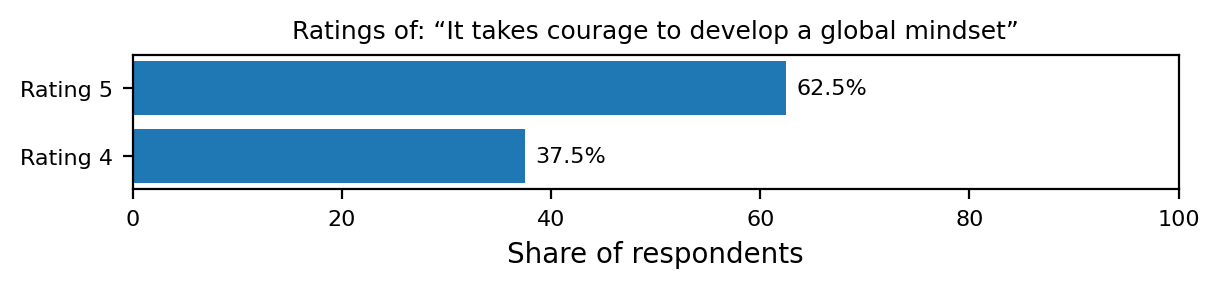
In the final module survey, all 24 respondents rated the statement “It takes courage to develop a global mindset” a 4 or 5 on a five-point scale. Fifteen students selected the highest rating, 5, and nine selected 4.
Students’ comments help explain what courage can look like in everyday life. One student described a lesson from a mentor:
“It pushed me to really examine how I interact with people and how I think through situations, rather than just accepting my first instinct. That shift has stuck with me beyond the specific advice itself.”
When Different Perspectives Challenge What We Believe
Global Gurus offered another view of this process. Tracey Gibbons described mentoring a student who spent a semester in Europe, where the student encountered different perspectives on political and economic events. Gibbons said the student found viewing these events “very illuminating,” though she struggled to reconcile her views with those of other students.
Students also valued conversations that opened up different ways of processing information:
“These discussions helped me see things from different perspectives and look at situations in a new light, changing how I process information.”
Encountering a different perspective does not require agreement. It can reveal how our understanding reflects where we come from and what we have experienced.
A global mindset means staying curious when differences arise: asking questions, listening and trying to understand why someone else sees an issue differently. Growth can begin with better understanding, even without agreement.
Changing Your Approach, Not Your Values
Another student described learning to adapt across cultures without giving up what they already knew:
“I learned how to navigate different cultural norms and adapt to new environments while staying true to what I know and remaining open to learning how things are done in different parts of the world.”
Reconsidering an assumption does not mean abandoning what matters to us. It can mean finding a more thoughtful or effective way to put our values into practice.
One student found that a mentor’s ideas opened up possibilities they had not considered:
“Meeting with my mentor broadened my perspective by introducing me to new ideas and ways of thinking I hadn't considered before.”
For students entering the workforce, this flexibility matters. Communication, collaboration and adaptability often require a change in approach without losing sight of personal goals.
The final module results also point to practical application: all 24 respondents rated the program’s help in applying global awareness and human skills to academic or career goals at 4 or 5.
Growth Takes Time
Developing a global mindset takes continued learning and reflection. Global Guru Aileen Nandi emphasized that this kind of growth unfolds over time, beyond a handful of conversations.
The cohort surveys offer a snapshot of students questioning assumptions, reconsidering familiar responses and becoming more intentional about how they engage with others.
These habits help people work across differences, navigate disagreement and make thoughtful decisions in an interconnected world.
A global mindset begins with seeing another perspective. The courage to change comes when we let that perspective challenge our assumptions and consider what we might do differently.
The Five-Part Series
This is the final story in the Open Mindset Project’s five-part series based on findings from the Spring 2026 cohort study.
The series explored how students develop a global mindset, from learning through mentorship and building human skills to seeing different perspectives and questioning their assumptions.
Together, the findings point to an important lesson: understanding the world differently matters, but growth happens when we allow what we learn to change how we think, connect with others and approach new challenges. That is the courage to change.
Explore the full series: Read the other stories from the Spring 2026 cohort study on the Open Mindset Project’s Impact page.